I am re-reading the novel
Push by Sapphire. I’ve always appreciated the importance of
Push and thought Sapphire brave for writing a story in the voice of a poor black teenager who is raped by her father. But I didn’t love the story when I read it in 1996, not the way that I loved
The Color Purple a book to which
Push is often compared. For me, The Color Purple was both brave and beautifully rendered.
Push was brave but it read more like reportage than fiction and not in an intentional genre-blurring way.
Now that
Push has been made into a film, I’m re-reading it to see how I feel this time around. One thing I’ve realized is that I’ve always been more interested in the background story surrounding the book than in the book itself. From day one, I’ve been curious about Sapphire, the experiences she had that inspired the story, the circumstances surrounding the novel’s publication, the public reaction to
Push. I remember reading in 1996 that Sapphire received a $500,000 advance for a two book deal. That was a lot of money in 1996. Given the depressed state of publishing in 2009, I think a first time novelist would be more than happy to receive that amount today.
(On another note, try to think of black literary writers who have scored big advances.
ZZ Packer got $250,000 for 2003's
Drinking Coffee Elsewhere.
Knopf paid Stephen L. Carter $4.2 million for 2002's
The Emperor of Ocean Park. Who else? Edwidge Danticat, who just received a MacArthur Genius Award,
was given a paltry $5,000 advance for
Breath, Eyes, Memory in 1994.)
Perhaps I was so invested in the publication of
Push because it came out the same year that I changed careers to pursue writing. In 1996 I began freelancing, I went to my first writing conference at Chicago State University, I began meeting other writers. I was so excited back then to be on the writerly path that reading about Sapphire’s advance made me believe that I’d made an inspired choice.
Later, I would hear stories that Sapphire had not finished writing
Push when she signed the book contract and that she was pressured by her publisher (Knopf) to develop the story in certain ways. I took that as advice to have my book finished before shopping it. A couple years later I interviewed Sapphire by telephone and listened to her describe, in retrospect, her frustration with the marketing of the book. She didn’t like the
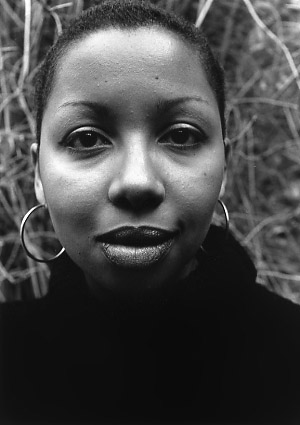
dust jacket photo that showed her staring into the camera, unsmiling. In that photo, she is dressed in a leather jacket with a fresh fade, a nose ring, and her expression is intense. She thought the photo was not flattering but provocative and that it was chosen to create controversy or hype for the novel. I remember ending the interview with the feeling that media attention had been a mixed blessing for her. I also remember talking with writers who hated
Push. They mocked Precious’s illiteracy as portrayed in the book, the use of “fahver” for "father," for example. There were people who complained (as they had with
The Color Purple) that the book demeaned black people and black men in particular.
The controversy around the book took on a life of its own.
Today I’m interested to know why Sapphire has not published another book of fiction. Is it perfectionism or life getting in the way? In a
recent interview with Katie Couric she says that she’s currently writing a novel, but what has taken so long? Does she still have a deal with Knopf? I also want to know how Sapphire made the transition from writing primarily poetry to writing a novel. Many writers do both (Sherman Alexie, Margaret Atwood, Ntozake Shange, Barbara Kingsolver, Louise Erdrich, Sandra Cisneros) but most writers are much better at one than the other. I want to know how her narrative skills and her use of point of view have changed since publishing
Push.
In the Couric interview, Sapphire talks about bringing the novel to the screen, of finding a director (Lee Daniels) whom she trusted with the story. Again the process of creating the art is fascinating to me, but I expect that the movie won’t be as interesting as the background story or the people involved in making it. Lee Daniels' dark artistic vision intrigues me.
In a NYT article Daniels is portrayed as a director who likes nontraditional casting and who gets actors to give unexpected performances. That's one way to view it. The casting of Mo'Nique, Mariah Carey and the inclusion of Tyler Perry as a producer also seems calculated to target a certain urban audience, and that makes me nervous about this adaptation.
After watching the Couric interview and thinking about
Push, what I’d like to see is this: a documentary about Sapphire! That would be an interesting story. Imagine watching a documentary about an artist named Ramona who is born during the baby boom and whose parents are in the military. A film about a woman who works as an erotic dancer
and literacy instructor. A film about a woman who witnesses the AIDS epidemic first hand, who forges her way into the New York poetry scene then the literary scene and who in her fifth decade of life conquers Hollywood. As they say, the real story is sometimes better than fiction.