Showing posts with label writing and identity. Show all posts

Writing at Age Five

Do you remember what you were writing at age five? I have homemade books that I created and school papers that I wrote from about age eight, but I don't recall my first scribblings of words.

Ava, our resident kindergartener, is a furious scribbler right now. In one year, it's gone from symbols:


to the random use of letters (on a homemade telescope):


to the creation of menus:


birthday cards:


copying words seen on art:


notes to her brother:


random thoughts:


and this morning, the creation of a computer keyboard:


BTW, Ava is NOT spelling "zucchini" or writing notes to her brother on her own. She has the initial idea, and then asks for help with the spelling.

Hello, Can Anybody Hear Me?

Last week I read responses that my students had written to assigned readings. One of the prompt questions was, "Who is the audience for this essay?" We'd talked in class about how you determine an author's intended audience. We'd talked about by noting where the work was first published, looking at the language, understanding the writer's themes. Still, when it came time to answer this question, most students wrote "African-Americans" for the essay written by a black man and "Latinos" for an essay written by a Mexican-American woman. I was a little shocked by their answers.

Both essays were literacy narratives that explored the writers' relationship with written and spoken language. I'm pretty sure the authors thought that they were writing about universal themes that many people could relate to. Yet, here was a group of college freshmen who believed that these writers spoke to an audience that was determined strictly by race.

* * * * *

Driving home at night I'm listening to the radio. Terry Gross, the host of "Fresh Air" announces that Jonathan Franzen will be the guest on her show. I let out a big sigh. I've heard the latest Twitterverse controversy about Franzen: Does he get unnecessary hype because he is a man? I'm tired. I've been working for twelve hours. I'm a woman writer that has yet to publish a book. Franzen is everywhere in the media. I'm thinking that this interview will be a downer.

Before I can change the station, I hear Gross ask him about the controversy. The way she phrases her question makes me cringe. She says something like "as if you're responsible for your success." Franzen responds. He says that the criticism of him has not been in the form of ad hominem attacks. He says it is a feminist critique about how we read and understand certain writers. He says he agrees with the critique.

* * * * *

I'm reading a review of Freedom that talks about Franzen's sharp insights into human nature. The example used is this quote from the book, "Then she waited, with parted lips and a saucy challenge in her eyes, to see how her presence--the drama of being her--was registering."

I remember that Terry Gross also quoted this description during her interview. I read and re-read the quote. I want to see the magic that they all see. It is hard to judge an excerpt without the context, but I just don't notice anything exceptional about the prose or even the mocking use of the word "saucy." It's a funny description of a character, but is it an acute observation into human nature? What if it appeared in a romance novel? Would the observation then be called brilliant?

* * * * *

Carleen Brice writes on her blog about the release of Getting to Happy, Terry McMillan's sequel to Waiting to Exhale. She remembers how McMillan's success inspired her to become an author. One commenter recalls how many people of different races were reading WTE when it first came out. I remember that, too. I remember that the person who first told me about the book was a girlfriend who is white.

* * * * *

I'm reading an essay by the poet Sarah Vap. It's about how readers and writers connect. In it, she writes, "If everything goes well in the reading of a poem--that is, if I have arrived at the poem with an opening in my heart and my mind to my own historical language, and if the author has written the poem with an opening in his or her heart and mind to their historical language--and if bridges have been crossed by both of us so that we intersect somewhere on the big continuum of language--then, I believe, the author and I will meet in the space of the poem. And in this meeting, our private histories with language will change forever. And so, because of this, we will also have to change."

I'm realizing how much baggage or "historical language" we all bring to reading any piece of writing. It really is a miracle when we create words that connect with an audience.

Post-Racial Era Discussions About Race

If you are getting tired of the shrill discussions about race that were sparked by the Shirley Sherrod firing, I suggest you check out these thoughtful pieces on race and publishing written over the last three years by black women writers:

"Writers Like Me" by Martha Southgate

"Reading Too Much Into Race
" by Carleen Brice

"Black Writers in a Ghetto of the Publishing Industry's Making
" by Bernice L. McFadden

"Readers, Rise Up"
by Tayari Jones

Last week, author Lori L. Tharps wrote a provocative piece on the networking site SheWrites where she asked for white ambassadors to help get the word out about her new book. I think Tharps intended for the piece to be a humorous and informative essay about the challenges black writers have in marketing their books, but based on the responses to the piece, I'm not sure her intentions were clear.

People have noted that Sherrod's NAACP speech was nuanced and talked about race in a way that was not simple. I think that anytime you're aiming for the truth, and not a soundbite, what you say will be nuanced. This is why writers and literature are so important, especially today amidst our fast paced media culture. Sometimes the quieter and more reflective voices have the most to say.

A Little of This. A Bit of That.

Here's an interesting essay in Slate magazine about taking ten years to write one novel.

Honoree Jeffers writes about the problems of contemporary black hip hop poetry in The Kenyon Review.

The winner of the Passion Project Contest on SheWrites will give an emerging writer all the tools she needs to put together a winning nonfiction book proposal.

The Idlewild Writers and Poets Conference will happen August 12-14 in Idlewild, Michigan. The focus of the conference is "the rich literary legacy associated with this historic African-American community known as one of the premier entertainment and performance venues during the 50s and early 60s."

An article in The Guardian chronicles how abandoned property in Detroit is being converted into farmland. I've been hearing stories about an increase in wildlife in once strictly urban areas. A friend who grew up in Southfield, Michigan with me says that her parents have a family of deer that visit their backyard regularly.

R.I.P. Harvey Pekar


I was so sad to read that Harvey Pekar, the comic book writer of the American Splendor series has passed away at 70. I loved how he embraced being ordinary, midwestern, awkward, and how he found humor in very ordinary experiences. The Washington Post has a piece about Pekar that includes this quote about his writing philosophy:

"The humor of everyday life is way funnier than what the comedians do on TV," Mr. Pekar once said. "It's the stuff that happens right in front of your face when there's no routine and everything is unexpected. That's what I want to write about."

If you've ever felt like a misfit, you've got to read Pekar's work or at least rent the movie American Splendor which stars the actor Paul Giamatti.

the tree of life


the tree of life
Originally uploaded by madstfri
I've been thinking a lot about one of my obsessions: parenthood from an artist's perspective. People have been buzzing about Who Does She Think She Is, a documentary about women artists and our competing demands of muse and family. Michael Chabon's 2009 interview on Fresh Air ran again. In it he talks about his book of essays, Manhood for Amateurs: The Pleasures and Regrets of a Husband, Father and Son. And I've been planning a creative project with two fabulous poets who are also mothers. When we get together we often discuss the way that our home lives influence our writing and our writing pedagogy since we also teach.

But this essay by writer Holly Kretschmar about eating her afterbirth (her baby's placenta, the "tree of life") was so unexpected, so weirdly fascinating that I had to share it. Only a writer could analyze what it means to eat yourself.

A Boy, Writing at age Ten


I can't think of a worse hell for a writer (especially one who spends any amount of time teaching) than realizing that your own child doesn't like reading or writing. I'm not there, but my son has definitely entered a new stage in his young life, one where he doesn't want to be bothered with written language.

Somebody just kill me already.

He reads every day, but only because he's encouraged to do so at home and because he has to read each night as part of his homework. But he's not into it. His lack of interest started over the last year. He can't seem to find any enthusiasm for the stories they read in his classroom textbook, and he's whizzing through short answers he has to give in school assignments without constructing complete sentences or adding punctuation. His comprehension isn't good either; I'm certain his mind drifts as he reads. And this is from a kid who babbled from the day he was born, whose first word had three syllables. I remember being happy that he conquered reading early with his beloved Ant Books.

A while back, I read Boys Adrift by Leonard Sax and Boy Writers:Reclaiming Their Voices by Ralph Fletcher. These books analyze how boys are systematically disengaged from learning (the Sax book) and writing (Fletcher's book).I recognized many of the problems the authors described from my experiences with male students in the classroom. These authors examine and critique education through the lens of gender, but if you add race to the equation and how the lack of cultural representation may affect a kid's interest in school and writing, there's another level to the problem that has to be undone.

I've started to come up with strategies. I'm looking into outside tutoring. I'm also tutoring him, but that's always a very delicate situation where emotions run high. I plan to inject more oral storytelling and discussion of stories in our conversations so that he becomes comfortable with narrative and how it works. I'm also searching for books that he will like, and I've made a note to ask him for the title of a book he recently read in one sitting.

It occurred to me on Sunday that I'm now homeschooling on the weekends, something I never planned to do. But I can see how important this moment is in his life, how his esteem is and will be affected by what happens next in his literacy. As we worked on writing answers to a story that we'd read together he started to cry. "I thought I understood how to do this," he said. I told him that he did know, that writing is a process, that we constantly work to improve our writing and the work of this is never done. I showed him a journal that published one of my stories in the fall of 2009. Then I pulled out the lined paper with my handwritten list of all the places where I considered sending that story. There were over sixty publications on the list. I actually sent the story to thirty-four journals. Only two of them were interested. "That's 'no' thirty-two times," I told him, "and that meant I had to look at the story several times and rewrite it many times to make it better." Then I said something corny about being a fighter and getting up when you get knocked down. He listened and gave me a half smile.

At that moment, it was the best thing I could think of to say.

Please Stop Ogling Me


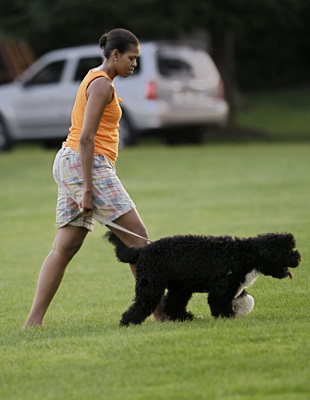
This week many critical eyes landed on the body of black women. Washington Post fashion writer Robin Givhan published a piece criticizing Michelle Obama for the shorts she wore as she descended from Air Force One during a recent vacation. Although Givhan—who is black, a Pulitzer Prize winning journalist and a Detroit native—did not mention race in the article, that topic appeared blatantly and in the subtext of many of the readers’ comments on WAPO and on The Root.com where the article also appeared. Readers referred to Mrs. Obama as a primate, Aunt Jemima and more. The argument that she should step up her fashion game because she “represents the race” was also made by a reader who wrote: “As a proud, professional black woman (in DC), I am appalled by the image that she is projecting to the world. She is being held to a different standard than she would be if she were another ethnicity…”

Givhan wanted to talk about fashion, pleasing aesthetics, and American culture, but she should have known that it wasn’t just the aesthetics of Obama’s shorts that got some people upset, but the black body that was visible in those shorts. She’s too muscular, not muscular enough, her butt’s too big and on and on the readers wrote.
Even if we remove race from the discussion, I think Givhan’s argument about aesthetics is wrong. Givhan wants a more polished (her word) aesthetic for the first lady because “Hers is a life of responsibilities and privileges. She gets the fancy jet. She has to dress for the ride.” Ok fine, so an occasion or office dictates an aesthetic. But who gets to define the aesthetic? Givhan? Fashion critics? Maybe Michelle Obama rejects traditional and ultra-feminine aesthetics. Maybe it’s time for the institution of the first lady to evolve.

Also this week, the New York Times ran an article about the politics of black hair, specifically black women’s hair. Last time I looked it was the Number 5 most read article on that site. That’s a lot of folks interested in black women’s hair. I don’t know, that topic gets a big yawn from me. I’ve worn my hair in many styles (straight and long, straight and short, locks, afro, twists) and while I recognize that there are politics that people associate with my hairstyles, I just don’t care what anyone thinks. I refuse to limit my options one way or another.

You can understand why women have so many issues with appearance when you see how much pressure we put on women to conform to certain norms. If you want to read a good blog on women and issues related to the body, go to Made Nekkid. It’s a new blog, started by a friend, Want Chyi. The first post, "A Day at the Zoo," is a good example of how messages about how women should look can get into your head and seriously mess with you.

Voices We Followed


This book was on my radar then fell off: Poems from the Women's Movement edited by Honor Moore was published this March 2009 and contains the work of 58 poets including Sylvia Plath, Adrienne Rich, Anne Sexton, Sonia Sanchez, May Swenson, Alice Walker, and Audre Lord. Moore says that she chose to cover work from 1966 when Plath publishes Ariel to 1982 when the Equal Rights Amendment failed to be ratified, but also when the number of women's poetry had exploded. You can read an essay by Moore on Boston Review here, and a review of the book on the Feminist Review blog, here.

Another book to buy. Good thing it's pay day...

A List in Honor of Sotomayor's Nomination


By now we've all heard the statement made by Supreme Court nominee, Sonia Sotomayor, that has been criticized by some politicians and journalists.

Sotomayor said:

"I would hope that a wise Latina woman, with the richness of her experiences, would more often than not reach a better conclusion than a white male who hasn't lived that life."

Although Sotomayor's critics say that her remark raises concerns about her judicial temperament (some have even called her racist), by all accounts her record reveals that she's been a fair and impartial judge.

Sotomayor's statement was part of a written presentation titled "A Latina Judge's Voice" that Sotomayor gave in 2001 at a lecture at the UC Berkeley School of Law. The remark has caused a mini-controversy for her nomination and prompted the NYT to publish an article asking whether identity politics is stylish once again.

Since I've been alive, racial identification has been exploited for political purposes; it's the reason we enacted civil rights legislation.

But that doesn't mean cultural and racial identification are bad.

Take the arts. I'm thankful that in the arts (generally-speaking) one's identity is not considered a handicap or something to play down. After all, an artist's sexual, cultural, and racial identity is crucial to her artistic voice. Many of the best writers explore the meaning of their identity or culture. What kind of literature would we have if one's life experiences or cultural practices were left out? Would the Nuyorican Poets Cafe and its influence on poetry have ever happened?

I think that reading the literature of a specific cultural group, of say, "writers from New York with Puerto Rican roots," may be a good way to broaden one's perspective about that culture, to teach tolerance, and to combat ignorance. So, in honor of the positive effects of cultural identification, here's a list of American writers with Puerto Rican roots (please feel free to add more writers that fit the description) :

Willie Perdomo
Judith Ortiz Cofer
Martin Espada
Miguel Algarin
Sandra Maria Estevez
Piri Thomas
William Carlos Williams
Pedro Pietri
Miguel Pinero